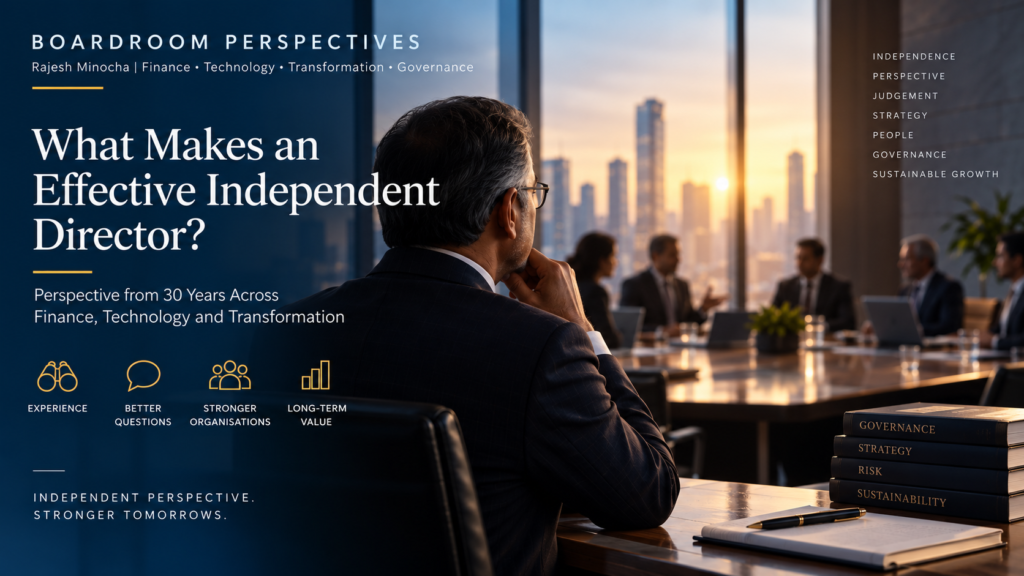
What Makes an Effective Independent Director?
Executive Summary
An effective Independent Director does not need to be the smartest person in the room.
They need to ask the right questions, understand the implications of management decisions, challenge constructively, connect seemingly unrelated issues, and maintain independent judgement.
Over more than 30 years, my career has taken me across financial services, technology, enterprise transformation and entrepreneurship, from ICICI to Wipro and Franklin Templeton, and eventually to building my own financial-services business.
These experiences have shaped how I think about leadership, risk, technology, capital allocation and long-term decision-making.
As I explore another chapter of my professional journey as an Independent Director, I increasingly believe that this combination of experiences can be valuable in the boardroom.
Not because I have seen everything.
But because I have seen enough different situations to know that the biggest risks and opportunities rarely sit inside one function.
A Board Needs More Than Financial Performance
One of the most important lessons from my early career in project finance was that financial numbers are only as useful as the assumptions behind them.
When people discuss Independent Director qualifications, the conversation often focuses on credentials.
- Finance expertise
- Legal knowledge
- Industry experience
- Technology understanding
- Governance certifications
All of these matter.
But I believe another dimension matters just as much: the ability to connect the dots.
A business decision may appear to be a technology decision.
But it could actually be a capital allocation decision.
A transformation program may look like an operational initiative.
But it could actually be a leadership and organisational-capability issue.
A rapidly growing business may appear to have a growth problem.
But the underlying issue could be governance, risk management or inadequate controls.
This ability to look beyond the immediate issue develops through experience.
My career has given me unusually broad exposure to these intersections.
My Career Did Not Follow a Straight Line
I began my corporate career in financial services.
At ICICI, my work included economic research, credit appraisal and project finance. Evaluating a project was not simply about determining whether the projected return looked attractive. It required understanding how much capital the business would consume, when cash flows would materialise, what assumptions were driving the projections and what could cause the project to underperform.
That experience shaped my approach to capital allocation: every investment decision is ultimately a decision about deploying scarce resources under uncertainty.
That is much more board-level than simply saying “ask questions.”
That experience taught me something fundamental about business judgement.
A business plan is never just a set of numbers.
Behind the numbers are assumptions about customers, competition, management capability, capital requirements, cash flows and execution.
A project can look financially attractive on paper and still fail because the assumptions underneath it are weak.
That lesson has stayed with me.
I subsequently moved into technology and business analysis, working with organisations including Polaris, HCL Technologies and Wipro.
This gave me another perspective.
Technology is not an isolated function.
It is a business enabler.
Understanding what the business is trying to achieve, translating that into technology requirements, and ensuring the technology actually works became a recurring part of my career.
At Wipro, I built an 80-member specialist testing organisation and personally interviewed approximately 800 candidates.
That experience reinforced another lesson: organisational capability is itself a strategic asset.
The right strategy with the wrong capabilities can fail.
Then Came Enterprise Transformation
My years with Franklin Templeton added another layer.
I moved across technology, operations, business excellence and transformation, and was a part of the 12-member India Management Committee throughout my tenure.
I was involved in technology investments, organisational development, operational excellence, business continuity and transformation.
I also established the firm’s first offshore Legal Shared Services Centre and built a 65-member Centralised Testing Services organisation.
One of the transformation programs delivered approximately 20% cost optimisation while maintaining delivery quality and business continuity.
The numbers are useful.
But the bigger lesson was not the 20%.
It was understanding how transformation actually happens.
Transformation is rarely about technology alone. It involves people, processes, leadership, governance, risk, communication, and ultimately, adoption.
That is highly relevant to the boardroom.
Boards do not implement transformation.
Management does.
But boards have an important responsibility to determine whether management has a credible strategy, appropriate resources, adequate controls and realistic assumptions.
Finally, I became an Entrepreneur
In 2016, I left corporate life and built Financial Radiance, a technology-enabled wealth-management business.
This was perhaps the most important learning experience of all.
As a corporate executive, there is always another function, team or support structure.
As an entrepreneur, the accountability becomes much more personal.
Strategy, revenue, costs, technology, compliance, risk, people, customer experience and cash flow eventually come back to the founder.
That changes how you think.
You become much more sensitive to trade-offs.
You understand that every decision has an opportunity cost.
You learn that growth without processes can create fragility.
You learn that technology without adoption creates expensive software.
You learn that controls that are too weak create risk, but controls that are unnecessarily cumbersome can destroy efficiency.
And you learn that long-term sustainability matters more than short-term appearances.
Entrepreneurship gave me the other side of the capital-allocation equation. I was no longer evaluating someone else’s business plan; I was responsible for making the decisions myself.
Where should I invest?
Where should I control costs?
When should I build capability ahead of demand?
How much risk is appropriate?
When does growth justify additional investment, and when does growth begin to create fragility?
These are not theoretical questions for an entrepreneur. They have immediate consequences for cash flow, customers, employees and the sustainability of the business.
These lessons are directly relevant to effective board oversight.
What Does This Mean for an Independent Director?
For me, the answer comes down to five principles.
1. Look Beyond the Numbers
Financial statements tell an important story.
But boards should also ask what is driving those numbers.
Is revenue growth sustainable?
Are margins improving because of structural advantages or temporary factors?
Is working capital becoming a concern?
Are capital requirements changing?
Are management assumptions still valid?
Good board oversight is not about challenging every number.
It is about knowing which numbers deserve deeper questions.
2. Understand Capital Allocation
Boards increasingly need technology fluency because technology affects strategy, capital allocation, customer experience and risk. But I see this as one part of a broader enterprise perspective rather than a standalone technology competency.
A board does not need to become a technology department.
But directors need enough technology fluency to ask management the right questions.
3. Test Strategy Against Execution
Strategy is only as good as the organisation executing it.
Does the organisation have the required capabilities?
Is leadership aligned?
Is succession being addressed?
Are incentives encouraging the right behaviours?
Is the transformation actually being adopted?
These questions often sit between strategy and operations, and that is precisely where boards can add value.
4. Understand Risk and Resilience
My financial-services and transformation experience has reinforced the importance of early signals.
A risk rarely arrives announcing itself as a major risk.
It may initially appear as:
- a recurring operational exception,
- customer complaints,
- increasing employee attrition,
- weak controls,
- technology dependencies,
- concentration,
- unrealistic assumptions,
- or an unresolved audit observation.
The board’s role is not to manage every emerging issue.
It is to ensure the organisation has mechanisms to identify and escalate issues that could materially affect the business.
5. Maintain Independent Judgement
This may be the most important principle.
An Independent Director should be willing to support management when the strategy is sound.
But should also be willing to ask difficult questions when something does not make sense.
Constructive challenge is not opposition.
It is part of governance.
The objective is not to prove management wrong.
The objective is to improve the quality of the decision.
The Common Thread Across My Career
Looking back, my career may appear to span very different areas:
Finance → Technology → Transformation → Entrepreneurship → Wealth Management → Board Governance
But I see a common thread.
It is the intersection of finance, business and technology, and the long-term decisions that connect them.
That is also how I see my potential contribution as an Independent Director.
I am not positioning myself as a specialist in every aspect of governance.
Rather, I bring a broad business perspective developed through three decades of seeing how financial decisions, technology choices, organisational capability and execution risks interact.
The IICA Independent Director Proficiency Assessment has given me an additional formal foundation in governance.
But I believe credentials are only the starting point.
The real test is whether a director can contribute meaningfully when the board is dealing with uncertainty, competing priorities and difficult decisions.
My Takeaway
The best Independent Directors, in my view, are not necessarily those who have the longest list of qualifications.
They are those who combine experience, curiosity, independence, judgement and the courage to ask the right questions.
Thirty years across different environments have taught me that businesses rarely fail because one person did not know one answer.
They struggle when important questions are not asked early enough.
That is perhaps the contribution I would most like to make in the boardroom:
A good Independent Director brings more than experience to the boardroom. They bring the ability to judge where capital, risk, capability and strategy intersect, and to challenge decisions that may look attractive today but weaken the institution tomorrow.
What do you believe is the most important judgement an Independent Director brings to a board, beyond functional expertise?