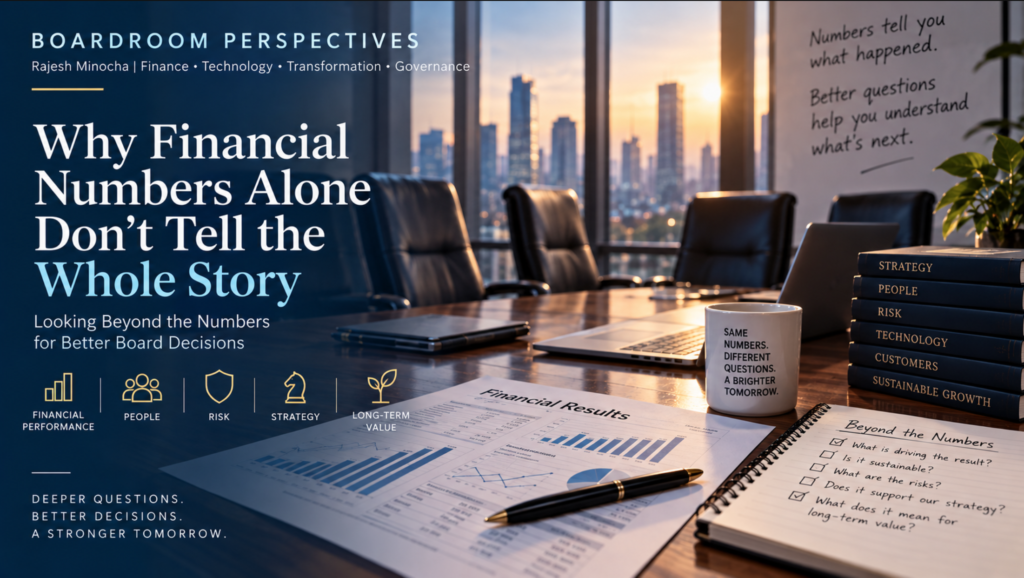
Why Financial Numbers Alone Don't Tell the Whole Story
Financial statements are one of the most important sources of information available to a board.
But they are not the whole story.
Revenue, margins, cash flows, debt, working capital and returns tell us what has happened. They can also hint at what may happen next.
But numbers rarely explain why something is happening.
A sudden improvement in margins could reflect genuine operational improvement, or temporary cost reductions. Strong revenue growth could indicate a successful strategy, or aggressive pricing, customer concentration or unsustainable expansion. Healthy cash balances may provide comfort while underlying working-capital pressures are building.
My career across financial services, technology, enterprise transformation and entrepreneurship has reinforced one lesson repeatedly:
Good board decisions require viewing financial numbers in their wider business context.
The board’s role is therefore not to get involved in management’s day-to-day financial analysis.
It is to ask the questions that connect financial performance with strategy, operations, people, technology, risk and long-term value creation.
Financial Numbers Tell Us What Happened
One of the earliest lessons I learned in my career came from the financial services industry.
During my time at ICICI, I worked in economic research, credit appraisal, and project finance.
The work required much more than reviewing financial statements.
A business seeking financing could present attractive revenue projections, healthy margins and apparently adequate cash flows.
But the real questions were underneath those numbers.
How realistic were the assumptions?
What was driving the projected growth?
Could the management team execute the plan?
How much capital would actually be required?
What could happen to cash flows if assumptions changed?
What were the key execution risks?
The numbers mattered enormously.
But the quality of the decision depended on understanding what was behind the numbers.
That lesson has remained relevant throughout my career.
Why Financial Performance Needs Context
Consider a company reporting strong revenue growth.
At first glance, that appears positive.
But a board might reasonably want to understand:
- Is growth coming from existing customers or new customers?
- Is it concentrated in a small number of customers?
- Are margins improving or deteriorating?
- What is happening to receivables?
- Is working capital keeping pace with growth?
- Is additional capital required?
- Is the growth sustainable?
- What assumptions underpin the next year’s projections?
The same financial number can therefore mean very different things depending on its context.
A 20% increase in revenue could represent a strong competitive position.
It could also represent a business taking on customers at uneconomic prices.
A 15% increase in profit could reflect genuine productivity improvement.
It could also result from temporarily lower spending that may eventually affect capability.
Cost reductions may improve this year’s margins while weakening the organisation’s ability to grow next year.
This is why I believe financial analysis and business analysis cannot be separated at board level.
Five Dimensions Behind the Numbers
I find it useful to think about financial performance through five additional lenses.
1. Understand the Drivers
The first question should be:
What is actually driving the number?
Revenue growth may come from volume, pricing, acquisitions, foreign exchange or a change in product mix.
Margin expansion may come from genuine productivity, lower input costs, pricing power or simply deferred expenditure.
Cash generation may be strong because the business is performing well, or because working capital has temporarily moved in its favour.
The board does not need to investigate every movement.
But material movements should have a clear explanation.
A useful board question is:
“What are the two or three underlying drivers that explain the majority of this change?”
That often leads to a much better conversation than simply asking whether the number is above or below budget.
2. Look at the People Dimension
Financial numbers don’t directly tell us whether an organisation can deliver its strategy.
Yet people can significantly impact future financial performance.
Consider:
- senior leadership attrition,
- inability to hire critical skills,
- weak succession planning,
- employee engagement,
- incentive structures,
- organisational capacity,
- dependence on a few key individuals.
A company may report excellent current results while simultaneously losing critical talent.
The financial statements may not show the consequences immediately.
But the board should be asking:
“What is happening inside the organisation that could affect these numbers twelve or eighteen months from now?”
This is where financial oversight meets organisational capability.
3. Consider the Risk Behind the Return
A high return is not automatically a high-quality return.
The board needs to understand how the return is being generated and what risks accompany it.
For example:
A business may be generating strong returns because it has excellent pricing power.
Or because it is taking unusually high leverage.
A financial institution may report strong growth.
But what is happening to asset quality?
A company may generate attractive cash flows.
But is there customer concentration?
Is the business dependent on a single supplier, technology platform or geography?
Is the organisation becoming increasingly exposed to regulatory or cyber risk?
The financial outcome may look attractive today while the risk profile is quietly changing.
That is why risk management and financial performance need to be considered together.
4. Assess the Strategic Context
Evaluate numbers against the strategy.
Suppose a company has invested heavily in digital transformation.
Operating expenses rise.
Technology costs increase.
Short-term profitability comes under pressure.
Looking only at current financial performance, the investment might appear negative.
But that is not enough.
The board should ask:
What strategic outcome was the investment intended to produce?
Has customer experience improved?
Has operating efficiency improved?
Has scalability increased?
Has risk reduced?
Has the organisation created a capability that competitors will find difficult to replicate?
Conversely, a company showing excellent short-term profitability may be under-investing in technology, people, product development or resilience.
The numbers may look better today while the competitive position weakens tomorrow.
Evaluate financial performance against strategic intent.
5. Focus on Long-Term Value
This may be the most important dimension.
Boards are responsible for overseeing the organisation’s long-term health, not simply maximising the next quarter’s numbers.
That requires looking beyond:
Revenue → Profit → EPS
and considering:
Customers → People → Technology → Risk → Capital → Resilience → Sustainable Growth
These factors eventually influence financial performance.
But they don’t always appear in the financial statements at the same time.
A company can improve current earnings by reducing investment.
It can improve cash flow by delaying payments.
It can improve margins by reducing training.
It can improve short-term returns by increasing leverage.
The question is not whether these actions are necessarily wrong.
The question is:
Are we improving the economics of the business, or simply improving the appearance of the current numbers?
That distinction matters enormously at board level.
What My Transformation Experience Taught Me
My years in technology and enterprise transformation reinforced this principle from another direction.
When I worked on large transformation initiatives, I couldn’t measure success simply by whether a project was delivered on time.
A system could go live and still fail to deliver the expected business benefit.
A process could be automated without actually improving customer experience.
A technology investment could reduce one cost while creating another.
An organisational redesign could look efficient on paper while weakening capability.
The same principle applies to financial reporting.
A metric is an outcome. It is not necessarily an explanation.
Boards need enough visibility to distinguish between:
Activity and impact.
Short-term improvement and structural improvement.
Reported performance and underlying business health.
The Board Questions I Would Ask
When reviewing financial performance, I believe directors can add considerable value by moving beyond:
“Why did revenue miss the budget?”
towards questions such as:
What is driving the variance?
Is it temporary or structural?
What assumptions have changed?
Are management’s original assumptions still valid?
What is not visible in these numbers?
Are there emerging risks or capability gaps that financial statements won’t capture yet?
What are we sacrificing to achieve this result?
Are cost reductions affecting customer experience, technology, talent or resilience?
What does this mean for the next three years?
Does today’s performance strengthen or weaken the organisation’s long-term competitive position?
These are not management questions in disguise.
They are board-level questions about performance quality and sustainability.
Financial Numbers Are the Starting Point
I am not suggesting that boards should look beyond financial numbers instead of looking at them.
Quite the opposite.
Strong financial oversight remains fundamental to effective governance.
The point is that financial statements provide a starting point for enquiry.
They tell us what has happened.
Good board oversight asks:
Why did it happen?
Is it sustainable?
What risks sit behind it?
What does it tell us about the business?
What should management be thinking about next?
This is particularly important as businesses become more complex.
Technology, artificial intelligence, changing customer behaviour, geopolitical developments, regulatory expectations and new business models can all affect financial outcomes long before their impact becomes obvious in reported numbers.
The board therefore needs the ability to connect finance with strategy, technology, people and risk.
My Takeaway
After working across finance, technology, transformation and entrepreneurship, I have come to appreciate that numbers are both powerful and incomplete.
They are essential for understanding business performance.
But they don’t tell us everything about a business’s health.
The best board conversations, in my view, happen when directors move from reviewing numbers to understanding the business behind those numbers.
That means looking at financial performance alongside:
- strategy,
- customers,
- people,
- technology,
- risk,
- capital allocation,
- resilience,
- and long-term value creation.
Ultimately, the board’s role is not to replace management’s financial analysis.
It is to ensure that important decisions are being made with a complete picture rather than an incomplete one.
Financial numbers are essential.
But they are the starting point, not the full story.
What do you believe is the most important business factor that financial statements often fail to capture?