GCC Governance: Cost Centre or Strategic Business?
Executive Summary
For years, Global Capability Centres (GCCs) were viewed primarily through a cost lens: lower operating costs, access to talent, and delivery efficiency.
That model is changing.
India’s GCC ecosystem has increasingly moved into technology, analytics, product development, R&D, AI, cybersecurity, and end-to-end business processes. According to EY’s GCC Pulse Survey 2025, 92% of GCCs surveyed identified value addition beyond cost arbitrage as part of their strategic mandate, while 87% reported increased ownership of end-to-end global processes.
This creates a governance question for boards:
If the GCC is becoming strategically important to the enterprise, can it still be governed primarily through cost and headcount metrics?
My view is that it should not.
A GCC does not necessarily need to become a separate profit centre. But once it owns critical capabilities, technology, intellectual property, risk or business outcomes, it needs business-level accountability, decision rights and performance measures.
The question is no longer simply, “How much does our GCC cost?”
It should increasingly be:
“What enterprise value does our GCC create, what risks does it introduce, and what capabilities should we invest in next?”
The GCC Has Outgrown the Cost-Centre Model
The original GCC proposition was relatively straightforward.
A global organisation could locate technology, finance, operations, analytics or support activities in India and obtain:
- access to skilled talent;
- lower operating costs;
- scalability;
- extended-hour or follow-the-sun delivery;
- process standardisation.
In that model, a cost-centre mindset made sense.
Management could reasonably ask:
How many people do we need?
What is the cost per transaction?
Are service levels being met?
Are we achieving the expected savings?
Those questions remain relevant.
The problem arises when they become the entire governance framework.
India’s GCC landscape has changed substantially. NASSCOM and Zinnov describe GCCs as moving beyond cost arbitrage into strategic innovation, with many centres taking ownership of end-to-end product lifecycles and high-value capabilities.
EY’s 2026 analysis similarly describes the evolution from execution centres toward strategic engines, with operating models increasingly involving broader ownership and greater decision-making authority.
Once a GCC builds products, develops AI capabilities, manages critical technology, owns global processes, or influences enterprise strategy, its governance model must evolve with its mandate.
The Important Distinction: Cost Centre vs Cost Discipline
There is a danger in overcorrecting.
Moving beyond the cost-centre model does not mean saying:
“Cost no longer matters.”
It absolutely does.
A GCC that cannot demonstrate cost discipline, productivity and operating efficiency should not automatically receive more strategic autonomy.
The better distinction is:
Cost-centre thinking
Cost is the primary measure of success.
versus
Business-oriented thinking
Cost is one component of value creation.
That distinction matters enormously.
A GCC might increase its technology budget by 20% and still create substantial enterprise value if that investment:
- reduces time to market;
- improves cyber resilience;
- creates reusable intellectual property;
- automates high-value processes;
- improves customer experience;
- enables a new product;
- reduces operational risk;
- or creates a capability that would otherwise be difficult to build.
Conversely, a GCC could reduce costs by 10% and destroy value if it does so by cutting the very capabilities that make the centre strategically important.
Boards should therefore ask about return on capability, not simply cost reduction.
Three Stages of GCC Governance
I would think about GCC governance as a maturity curve.
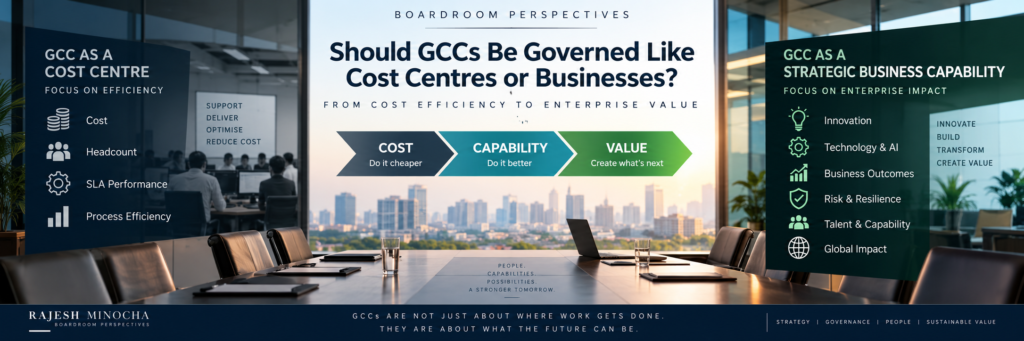
1. The Cost Centre
The GCC primarily executes defined processes.
Typical measures:
- cost;
- productivity;
- SLA performance;
- headcount;
- utilisation;
- process efficiency.
Here, centralised governance and tight budget control can be appropriate.
2. The Capability Centre
The GCC begins to own specialised capabilities.
Examples include:
- data and analytics;
- cybersecurity;
- cloud;
- AI;
- finance transformation;
- engineering;
- product support;
- global centres of excellence.
Now the board should start asking different questions:
What capabilities are we building?
Are they strategically differentiated?
Are we retaining the talent required to sustain them?
Are we investing sufficiently ahead of demand?
What risks arise from concentrating these capabilities in one location?
The GCC is no longer simply delivering work.
It is building organisational capability.
3. The Strategic Business Capability
At the most mature stage, the GCC becomes deeply integrated into enterprise strategy.
It may:
- own global processes;
- develop products;
- build intellectual property;
- drive AI adoption;
- influence technology architecture;
- support global innovation;
- participate in enterprise decision-making.
EY’s recent GCC research found that 45% of surveyed centres participated in global decision-making, while 87% owned end-to-end global processes.
At this point, governing the GCC primarily through headcount and cost-per-transaction metrics is inadequate.
The board should be asking:
What business outcomes does the GCC own?
What Should Boards Govern Differently?
The shift from cost centre to business capability requires changes in five areas.
1. Mandate
The first question is:
What exactly is the GCC expected to own?
A vague mandate creates a vague governance model.
Boards should understand whether the GCC is primarily:
- an execution centre;
- a shared-service organisation;
- a centre of excellence;
- a product and engineering hub;
- an innovation centre;
- or a strategic capability embedded into the global operating model.
The governance expectations should follow the mandate.
2. Decision Rights
A GCC cannot be held accountable for outcomes while headquarters retains every meaningful decision.
This creates an important board question:
Does the GCC have enough authority to deliver what it is being held accountable for?
If the GCC owns technology transformation but cannot influence technology architecture, talent or investment decisions, accountability becomes superficial.
EY’s research notes that more mature GCC models increasingly distribute decision rights and give GCC leadership greater ownership.
3. Capital Allocation
This is where the board’s role matters most.
GCC investment should not be assessed solely on:
“How much cheaper is India?”
The more useful question is:
“What is the expected enterprise return on the capabilities we are building in India?”
Consider a GCC investing in AI.
A narrow cost-centre assessment might ask:
How many employees will AI replace?
A business-oriented assessment would ask:
What revenue, productivity, resilience, decision quality or innovation capacity could this capability create?
That is a fundamentally different capital-allocation conversation.
4. Risk and Resilience
A strategically important GCC can also become a concentration risk.
If critical technology, operations, data, engineering or financial processes are increasingly concentrated within one location, boards need visibility into:
- business continuity;
- cyber risk;
- data protection;
- talent concentration;
- geopolitical exposure;
- infrastructure dependency;
- key-person risk;
- third-party dependency;
- succession.
The more strategically important the GCC becomes, the more important resilience governance becomes.
5. Performance Measurement
The KPI dashboard needs to evolve.
A mature GCC should not be judged only on:
Cost | Headcount | SLA | Productivity
It should increasingly include:
Business value | Innovation | Time-to-market | Capability maturity | Risk reduction | Customer outcomes | IP creation | Talent depth
The right dashboard is therefore not:
“How efficiently is the GCC doing the work?”
but:
“How effectively is the GCC improving the enterprise?”
What Should the Board Ask?
For boards overseeing organisations with significant GCC operations, I would suggest these questions:
Strategy
- What strategic capabilities does our GCC own today?
- What do we expect it to own in three years?
Capital Allocation
- Are we measuring GCC investments by cost savings or enterprise value?
- Which capabilities deserve additional investment even if they increase near-term cost?
Governance
- Do GCC leaders have sufficient decision rights to be accountable for outcomes?
- Is accountability clearly divided between global headquarters and the GCC?
Risk
- What critical enterprise capabilities are now concentrated in India?
- What would happen if the GCC were disrupted for 30 days?
Talent
- Are we building scarce strategic capabilities or simply scaling headcount?
- Can the GCC attract and retain the leadership talent needed for its expanded mandate?
Technology & AI
- Are AI investments solving enterprise problems or simply following the technology narrative?
- Who is accountable when AI-enabled decisions create business, regulatory or reputational risk?
These are not questions for the GCC leadership team alone.
They are increasingly board questions.
The Board-Level Test
I would use a simple test:
If the GCC primarily… | Governance emphasis |
Executes defined processes | Cost, efficiency, controls |
Owns specialised capabilities | Capability, talent, investment |
Owns end-to-end processes | Business outcomes, risk, decision rights |
Builds products/IP/AI | Strategy, capital allocation, innovation, governance |
Influences enterprise strategy | Enterprise value, resilience, accountability |
The objective isn’t to abandon cost discipline.
It is to ensure that governance sophistication keeps pace with strategic importance.
Conclusion
The question should therefore not be:
“Should GCCs be governed as cost centres or businesses?”
The better question is:
“What governance model matches the GCC’s strategic mandate and maturity?”
An early-stage GCC may legitimately require cost-centre discipline.
A mature GCC that owns technology, processes, intellectual property, innovation and strategic capabilities requires something more.
It needs business accountability without necessarily becoming a standalone profit centre.
That distinction is important.
The future of GCCs is not about moving from cost to no cost. It is about moving from cost as the objective to cost as one input into enterprise value creation.
For boards, that means asking harder questions about mandate, decision rights, capital allocation, risk, talent and measurable business outcomes.
Once a GCC becomes strategically important to the enterprise, governing it like a back office becomes a governance risk.
Board takeaway
A GCC does not need to become a profit centre to be governed like a business. It needs clear accountability for capabilities, capital, risk and outcomes.
Sources & Further Reading
EY India: Global Capability Center (GCC) Pulse Survey 2025, November 2025.
The survey examines the evolving strategic mandate, operating models, technology and transformation priorities, talent, risk and governance of GCCs in India.
Read the full EY GCC Pulse Survey 2025
EY India – India’s GCCs are leading the shift to Intelligent, AI-native enterprises, November 2025.
Read the EY analysis of the survey findings
Learn more about Rajesh’s Independent Director and board governance perspective.