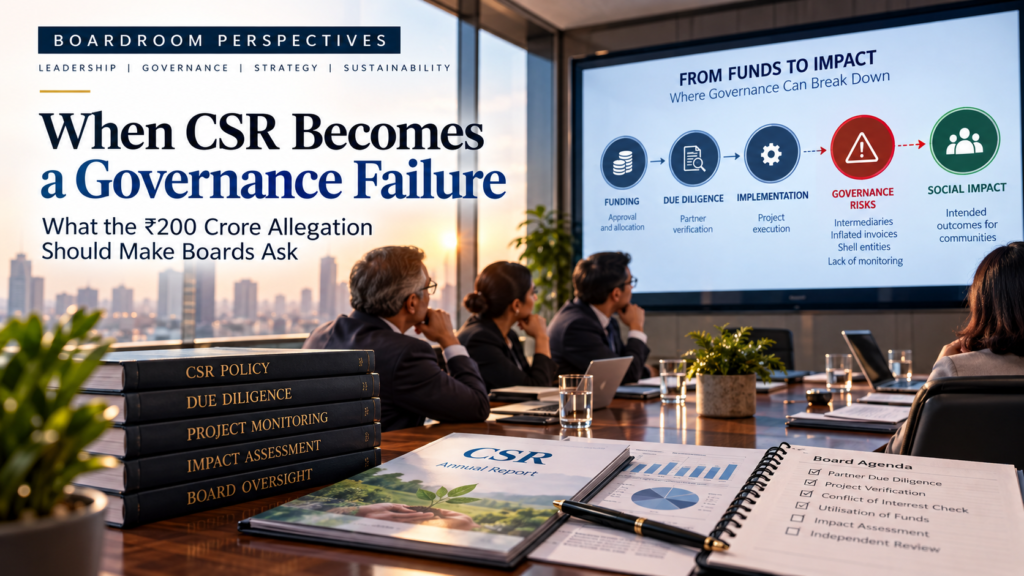
When CSR Becomes a Governance Failure: What the ₹200 Crore Allegation Should Make Boards Ask
Executive Summary
Corporate Social Responsibility was never meant to be just another line item in a company’s annual report.
It is intended to direct corporate resources towards activities such as healthcare, education, sanitation, rural development, environmental sustainability and other areas specified under Schedule VII of the Companies Act.
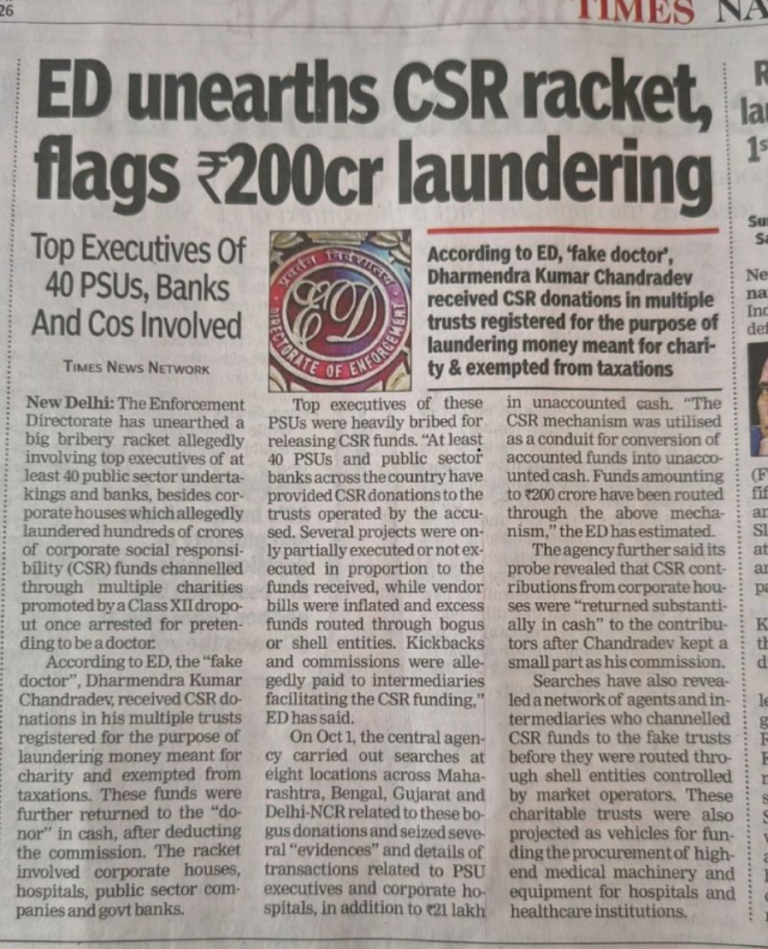
That is why the recent Enforcement Directorate investigation into an alleged ₹200 crore CSR fund diversion and money-laundering network deserves attention well beyond the immediate case.
According to the ED, searches conducted across eight locations uncovered an alleged network involving charitable trusts, CSR agents, intermediaries, equipment suppliers and shell entities. The agency said at least 40 PSUs and public-sector banks had provided CSR donations to trusts linked to the accused. It also alleged that several projects were only partially executed, or not executed at all, relative to the funds received, while vendor bills were inflated and excess funds were routed through bogus or shell entities. The searches seized approximately ₹21 lakh in cash.
These are allegations, not convictions.
But even at the allegation stage, the case raises uncomfortable questions.
How could such a network receive CSR money from so many large institutions?
And perhaps the more important boardroom question:
What controls existed between approving a CSR proposal and verifying that the promised social impact actually happened?
That is where this story becomes a governance issue.
CSR Is Not Just About Spending the Money
India’s CSR framework places responsibilities on the board and CSR committee around the utilisation and monitoring of CSR funds. The framework also requires companies to disclose CSR activities and implementing agencies.
But there is a fundamental difference between:
“We spent ₹X crore on CSR.”
and
“₹X crore produced the intended social outcome.”
The first is a financial transaction.
The second is governance.
And that distinction matters enormously.
If a company transfers money to an implementing organisation, receives documentation and records the expenditure, it may appear that the process is complete.
But what if the project was never fully executed?
What if equipment purchased on paper never reached the intended beneficiary?
What if invoices were inflated?
What if an intermediary influenced the selection of the implementing agency?
What if the organisation that received the money had impressive credentials but inadequate capability?
The board cannot outsource its responsibility simply because an external entity is involved.
1. Who Actually Performed the Due Diligence?
This is perhaps the first question boards should ask.
Before approving a substantial CSR allocation, who verified the implementing organisation?
Not just its registration.
Not just its website.
Not just its presentation.
Not just the recommendation that came through an influential channel.
The real due diligence should examine:
- Who are the trustees or directors?
- What is their track record?
- Have they executed similar projects before?
- What projects have they completed?
- Who were their previous donors?
- Are their financial statements credible?
- Are there related parties?
- Are there common directors, vendors or intermediaries?
- What is their actual operating capability?
- Can the proposed project be independently verified?
The CSR Rules have historically contemplated eligibility and track-record requirements for certain implementing agencies, while the framework has evolved over time. Ministry of Corporate Affairs
But compliance with eligibility criteria should be viewed as the starting point of due diligence, not the finishing point.
A registered entity can still be poorly governed.
A legitimate-looking organisation can still fail to deliver.
A recommendation can still be wrong.
2. Who Verified the Project? Not Just the Paperwork
This is where CSR governance becomes particularly important.
Suppose a CSR proposal is for medical equipment for a hospital.
The board should ultimately be able to answer:
Was the equipment actually purchased?
Was it delivered?
Is it physically present?
Is it operational?
Is it being used by the intended beneficiaries?
Who independently verified this?
The same principle applies to a school, sanitation project, rural development initiative, skill-development programme or any other CSR activity.
Paperwork can establish that a transaction occurred.
It does not necessarily establish that impact occurred.
The Companies Act framework itself places monitoring responsibility with the CSR committee and board.
That raises an important governance principle:
The larger the CSR allocation, the greater the need to independently verify outcomes.
3. Should Recommendations Ever Substitute for Due Diligence?
The reported investigation raises another uncomfortable issue: the role of recommendations and intermediaries.
A recommendation can be useful.
Someone may know a credible NGO or a genuine healthcare organisation.
But a recommendation should never replace institutional due diligence.
A board should be able to ask:
Would we have approved this organisation without a recommendation?
That is a deceptively powerful question.
If the answer is no, the governance process may already have been compromised.
The same principle applies to government, political, business or personal relationships.
Influence may open a door.
It should not eliminate the checks behind that door.
4. Where Is the Conflict-of-Interest Check?
CSR decisions can involve a surprisingly large ecosystem:
Company → CSR committee → implementing agency → trustees → project partner → vendors → consultants → intermediaries → beneficiaries
Every additional participant introduces another potential conflict.
Boards should therefore ask:
- Does anyone involved have a personal or business relationship with the implementing agency?
- Are any vendors related to trustees or management?
- Are intermediaries being paid?
- Who introduced the implementing organisation?
- Who negotiated the commercial terms?
- Are procurement decisions independently reviewed?
- Have related-party and conflict-of-interest declarations been obtained?
The objective is not to assume wrongdoing.
It is to make conflicts visible before they become problems.
Good governance does not depend on everyone being incorruptible.
It depends on systems that make inappropriate behaviour difficult to hide.
5. Who Is Accountable When Things Go Wrong?
This is perhaps the biggest boardroom question.
Imagine that ₹10 crore is allocated to a major CSR project.
Three years later, the project has not delivered what was promised.
Who answers for it?
The implementing agency?
The CSR head?
The CFO?
The CEO?
The CSR committee?
The board?
The answer cannot simply be:
“We gave the money to an NGO.”
Delegating execution does not necessarily mean delegating accountability.
The board needs a clear chain of responsibility from approval to monitoring to closure.
And accountability should not begin only after an enforcement agency arrives.
The ₹200 Crore Question Is Actually Much Bigger
The reported figure of approximately ₹200 crore is obviously striking.
But the more important number may be 40.
According to the ED, at least 40 PSUs and public-sector banks had provided CSR donations to the trusts under investigation. Hindustan Times
That should make every board member pause.
Not because it proves that all 40 institutions failed.
It doesn’t.
The investigation is ongoing, and individual roles and facts have yet to be established.
But it does raise a systemic question:
When multiple large institutions independently interact with the same implementing ecosystem, why didn’t their collective due diligence mechanisms identify the warning signs earlier?
That is a very different question from:
“Who committed the fraud?”
Law enforcement will investigate that.
Boards should ask:
“What allowed the system to become vulnerable?”
CSR Needs a Three-Level Control Framework
Perhaps the lesson is that CSR needs the same seriousness boards apply to other significant financial allocations.
I would suggest three levels of control.
1. Before Approval: Due Diligence
Verify the implementing organisation, people, track record, financials, conflicts and project feasibility.
2. During Execution: Independent Monitoring
Don’t wait until the annual report.
Verify milestones, procurement, utilisation, physical progress and beneficiary outcomes.
3. After Completion: Impact Verification
Ask whether the project actually delivered what it was intended to deliver.
Money spent ≠ project completed.
Project completed ≠ impact achieved.
That distinction should be central to CSR governance.
What Should Boards Be Asking Now?
For companies with significant CSR programmes, this incident should prompt a governance review.
Here are ten questions worth putting on the board table:
- How do we select our CSR implementing partners?
- Who independently verifies their credentials and track record?
- How do we identify conflicts of interest?
- How much of our CSR spend goes through intermediaries?
- Who independently verifies that projects have actually been executed?
- Do we physically verify major assets and infrastructure created through CSR?
- What happens when project delivery falls materially short of the original proposal?
- Are payments linked to measurable milestones wherever appropriate?
- Can our internal audit function independently examine CSR projects?
- Does the board receive enough information to challenge CSR decisions rather than simply note them?
These are not questions designed to slow CSR down.
They are designed to protect its purpose.
The Board’s Responsibility Is Bigger Than Compliance
There is a temptation in governance to ask:
“Did we comply with the rules?”
That is necessary.
But boards should ask a second question:
“Would we be comfortable explaining this decision publicly if every document, relationship and payment became visible tomorrow?”
That is a much higher standard.
And perhaps the right one.
CSR funds are not ordinary corporate expenditure.
They carry an expectation from employees, shareholders, regulators and, most importantly, the communities they are intended to serve.
When those funds are misused, the damage extends beyond the financial loss.
It damages trust in corporate philanthropy.
It damages the credibility of genuine NGOs.
It damages the reputation of companies that take CSR seriously.
And ultimately, it damages the people for whom those funds were intended.
The Hardest Governance Question
The recent investigation should not lead us to conclude that CSR is inherently flawed.
Nor should it lead us to prejudge the organisations or individuals currently under investigation.
But it should force boards to confront a difficult question:
Are we measuring CSR by money transferred, or by outcomes delivered?
Because if a company can demonstrate that it spent the required amount but cannot demonstrate where the money went, what was delivered and who benefited, then something important is missing from the governance framework.
CSR should not become “compliance with a cheque.”
It should be capital with accountability.
And perhaps the most important lesson for boards is this:
Trust is not a control.
A recommendation is not due diligence.
A registration certificate is not proof of capability.
An invoice is not proof of delivery.
And expenditure is not proof of impact.
Board Takeaway
The real test of CSR governance is not whether the company spent the money.
It is whether the board can demonstrate that the money reached the intended purpose, and that someone independently verified it.
A Note on the Current Investigation
The facts concerning the alleged CSR racket, the trusts, the accused individual, the PSUs/PSBs and the alleged diversion of funds are based on the Enforcement Directorate’s October 2026 disclosures and contemporaneous reporting. The ED says approximately ₹200 crore in CSR funds were routed through the alleged network and that approximately ₹21 lakh in cash was seized during searches.
These are allegations under investigation, not judicial findings of guilt. An institution or individual’s connection to the investigation should not itself be treated as evidence of wrongdoing. In particular, the widely reported claim that executives of 40 PSUs were bribed should not be presented as an established fact; the ED’s own public description establishes that the 40 PSUs/PSBs had provided CSR donations and describes alleged intermediaries, kickbacks and diversion, but the individual culpability of particular executives remains a matter for investigation and due process. Enforcement Directorate
That distinction matters, and, in my view, good governance requires this discipline of separating facts, allegations, and conclusions.
Learn more about Rajesh’s Independent Director and board governance perspective.