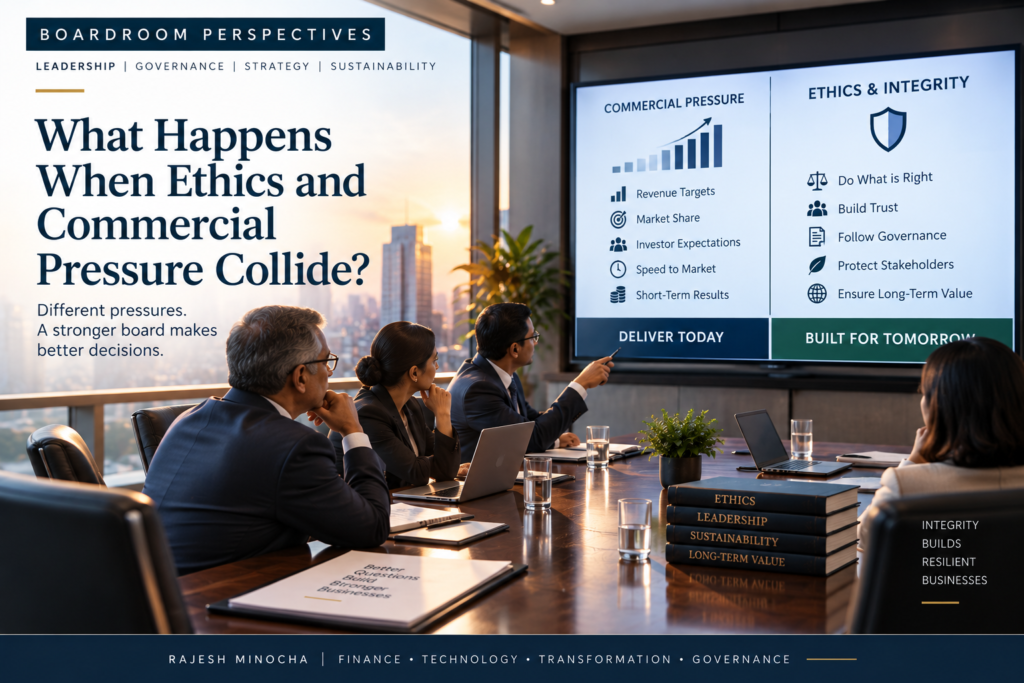
What Happens When Ethics and Commercial Pressure Collide?
Executive Summary
Every organisation talks about ethics.
Most have a code of conduct. Most have compliance policies. Most expect employees and leaders to act with integrity.
The real test comes when doing the right thing costs money.
A major customer is at risk.
A quarterly target is under pressure.
A product launch is delayed.
A deal is almost signed.
A regulatory requirement creates an unexpected cost.
A senior executive wants an exception.
A sales team says that competitors are doing things differently.
This is where ethics moves from policy document to leadership decision.
The board’s role is not to make every operational ethical decision. It is to ensure that the organisation has the culture, incentives, controls and escalation mechanisms that allow people to make the right decision when commercial pressure is at its highest.
The G20/OECD Principles of Corporate Governance explicitly recognise the board’s role in setting an organisation’s ethical tone and ensuring incentive structures align with ethical and professional standards.
The difficult question is therefore not:
“Does the company have an ethics policy?”
It is:
“What happens when following that policy makes the business outcome harder?”
Ethics Is Easy When There Is Nothing to Lose
It is relatively easy to demonstrate integrity when the ethical choice and the commercial choice point in the same direction.
The real test comes when they don’t.
Imagine a salesperson who discovers a customer has misunderstood an important contract condition.
Correcting the misunderstanding could jeopardise the deal.
Or consider a management team that knows a project will miss its target but believes that delaying recognition of the problem for another quarter will give them time to recover.
Or a business unit that discovers a control is slowing down customer onboarding at a time when aggressive growth targets have been set.
None of these situations necessarily begins with deliberate misconduct.
They begin with pressure.
And pressure changes behaviour.
Auditing standards explicitly recognise excessive pressure to meet financial targets, sales goals and profitability expectations as factors that can increase fraud risk.
That is why boards need to look beyond policies and examine the environment in which decisions are actually made.
1. What Behaviour Are Our Incentives Really Rewarding?
One of the most important questions a board can ask is:
“What behaviour does our incentive system encourage?”
An organisation may officially say:
“We value integrity.”
But if compensation depends overwhelmingly on revenue, profit, market share or quarterly targets, employees may receive a very different practical message.
The problem is not performance measurement itself.
Businesses need targets.
The problem arises when the method of achieving the target becomes secondary to achieving it.
For example:
- Are sales targets achievable without compromising customer interests?
- Are managers rewarded for sustainable performance or simply short-term numbers?
- Are compliance breaches considered when determining incentives?
- Can someone who delivers exceptional financial results but repeatedly violates controls still receive the highest rewards?
- Are managers encouraged to escalate bad news early?
The OECD has specifically highlighted the importance of aligning incentive structures with ethical and professional standards so that appropriate conduct is rewarded and breaches have consequences.
The board should therefore examine not just the organisation’s stated values, but the economic consequences attached to behaviour.
Because people pay attention to what gets rewarded.
2. Can Bad News Travel Upward?
A healthy organisation is not one in which bad things never happen.
It is one where bad news reaches the right people early enough to act.
Commercial pressure can make this difficult.
A manager may hesitate to tell the CEO that a major project is failing.
A salesperson may not want to report a customer complaint because it could affect the team’s numbers.
A finance executive may hesitate to challenge an aggressive accounting assumption.
A junior employee may notice something uncomfortable but decide that raising it could damage their career.
The board should therefore ask:
“How do we know what management doesn’t want to tell us?”
That is a powerful governance question.
The G20/OECD Principles recommend effective whistleblowing mechanisms that preserve integrity, independence and confidentiality and encourage reporting of unethical or unlawful behaviour without fear of retribution.
Boards should understand:
- What channels exist for escalation?
- Who receives whistleblower complaints?
- Can employees bypass management when necessary?
- Does the audit committee have direct access to relevant information?
- How are complaints investigated?
- Are patterns and recurring issues reported to the board?
A whistleblowing mechanism is not merely a compliance requirement.
It is an early-warning system for governance.
3. What Happens When a High Performer Crosses the Line?
This is perhaps the hardest test of culture.
Imagine an executive who consistently delivers exceptional commercial results but repeatedly ignores controls, intimidates colleagues or takes shortcuts.
What happens?
If the organisation looks the other way because the person is commercially valuable, employees learn something far more powerful than anything written in the code of conduct.
They learn:
“The rules apply differently to people who deliver results.”
That creates a dangerous cultural signal.
The OECD principles emphasise the board’s role in setting high ethical standards and overseeing management, internal controls, conflicts of interest and whistleblowing mechanisms.
This does not mean every mistake should become a disciplinary matter.
There is an important distinction between:
- an honest mistake,
- a poor judgement call,
- a process failure,
- deliberate concealment,
- and intentional misconduct.
Good governance requires making those distinctions carefully.
But commercial success cannot become a blanket exemption from ethical standards.
4. Does the Board Hear the Same Story as Management?
Ethical pressure can also manifest through information asymmetry.
Management may present the board with strong financial results while the underlying organisation is experiencing:
- increasing customer complaints,
- employee attrition,
- control exceptions,
- regulatory concerns,
- rising unresolved audit issues,
- aggressive sales practices,
- or growing operational stress.
Each indicator may appear manageable in isolation.
Together, they may tell a different story.
This is why boards need information beyond headline financial performance.
The board should consider whether dashboards include relevant non-financial indicators alongside financial measures.
For example:
Financial Indicator | Complementary Governance Indicator |
Revenue growth | Customer complaints |
Sales performance | Mis-selling / conduct issues |
Profitability | Employee turnover |
Cost reduction | Control exceptions |
Project milestones | Risk escalations |
Shareholder returns | Regulatory / compliance issues |
The purpose is not to create another enormous board pack.
It is to ensure commercial performance does not become the only lens through which organisational health is viewed.
5. Can People Say “No” Without Paying a Price?
Ethical culture ultimately depends on whether people feel able to challenge decisions.
A board should ask:
“What happens to the person who says no?”
If someone challenges a questionable practice, do they get heard?
Or are they labelled as:
- not commercially minded,
- difficult,
- negative,
- lacking urgency,
- or not being a team player?
This is where culture becomes tangible.
People watch what happens to colleagues who raise uncomfortable questions.
The formal message may be:
“Speak up.”
But if the informal message is:
“Don’t create problems for the business,”
employees will understand which message really matters.
The board therefore has an interest in understanding whether challenge is genuinely welcomed, particularly in functions such as finance, risk, compliance, legal, internal audit and technology.
The Board’s Role: Set the Conditions for Ethical Decisions
Boards cannot personally monitor every commercial decision.
Nor should they.
Their responsibility is to establish the conditions in which management and employees can make those decisions responsibly.
That means asking questions such as:
Incentives
- Are performance targets encouraging undesirable behaviour?
Culture
- Can employees challenge senior management?
Controls
- Are important controls being bypassed in the name of speed?
Escalation
- Does bad news reach the board early?
Accountability
- Are ethical standards applied consistently?
Information
- Does the board see indicators beyond financial performance?
Leadership
- Do senior executives demonstrate the standards expected of everyone else?
These are governance questions, not operational micromanagement.
When Commercial Pressure Is Highest, Governance Matters Most
Ethics should not be viewed as something separate from business performance.
Trust, reputation, regulatory relationships, customer confidence and organisational culture all have commercial consequences.
But the reverse is equally important:
Commercial pressure can weaken ethical decision-making if governance systems are poorly designed.
That is why boards need to examine the interaction between strategy, incentives, culture, risk and ethics.
The objective is not to eliminate commercial ambition.
Healthy organisations need ambition.
The objective is to ensure that pursuing commercial outcomes does not quietly redefine what the organisation considers acceptable.
Five Questions Every Board Should Ask
When commercial pressure is high, the board could ask:
- What behaviours are our current incentives encouraging?
- How would we know if employees were afraid to raise concerns?
- Would our highest-performing executives be held to the same ethical standards as everyone else?
- What non-financial indicators could tell us that commercial performance is creating hidden risks?
- If someone in management disagrees with a commercially attractive decision on ethical grounds, what happens next?
These questions are not about assuming that something is wrong.
They are about ensuring the organisation can recognise when pressure begins to distort judgement.
The Real Test of Corporate Values
A company’s values are easiest to demonstrate when doing the right thing is also profitable.
The harder test comes when the ethical choice is slower, more expensive or commercially inconvenient.
That is when leadership matters.
That is when incentives matter.
That is when culture matters.
And that is when the board’s role becomes particularly important.
The board does not need to decide every ethical question.
But it should ensure the organisation has an environment where people can raise difficult questions, challenge assumptions, escalate concerns, and make principled decisions without fear of retaliation.
Because ultimately, corporate ethics is not tested by what appears in the code of conduct.
It is tested by what happens when following that code costs something.
Board Takeaway
Culture is revealed under pressure.
The real test of an organisation’s ethics is not what it says when business is going well, but what it does when doing the right thing becomes commercially difficult.
Learn more about Rajesh’s Independent Director and board governance perspective.