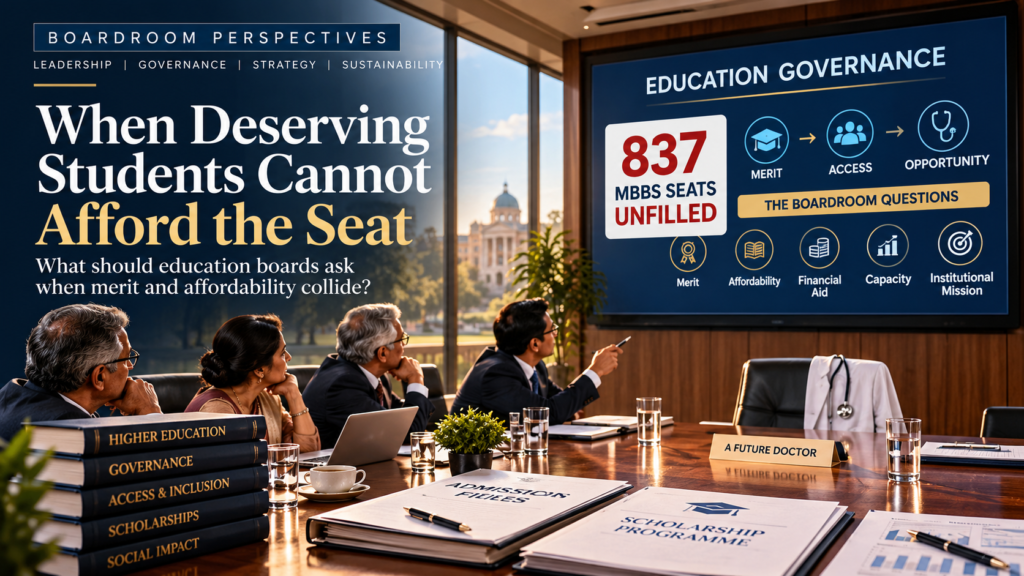
When Deserving Students Cannot Afford the Seat: What Should Education Boards Ask?
Executive Summary
A recent report about hundreds of MBBS seats remaining vacant after the final NEET-UG counselling round raises a question that goes beyond medical education.
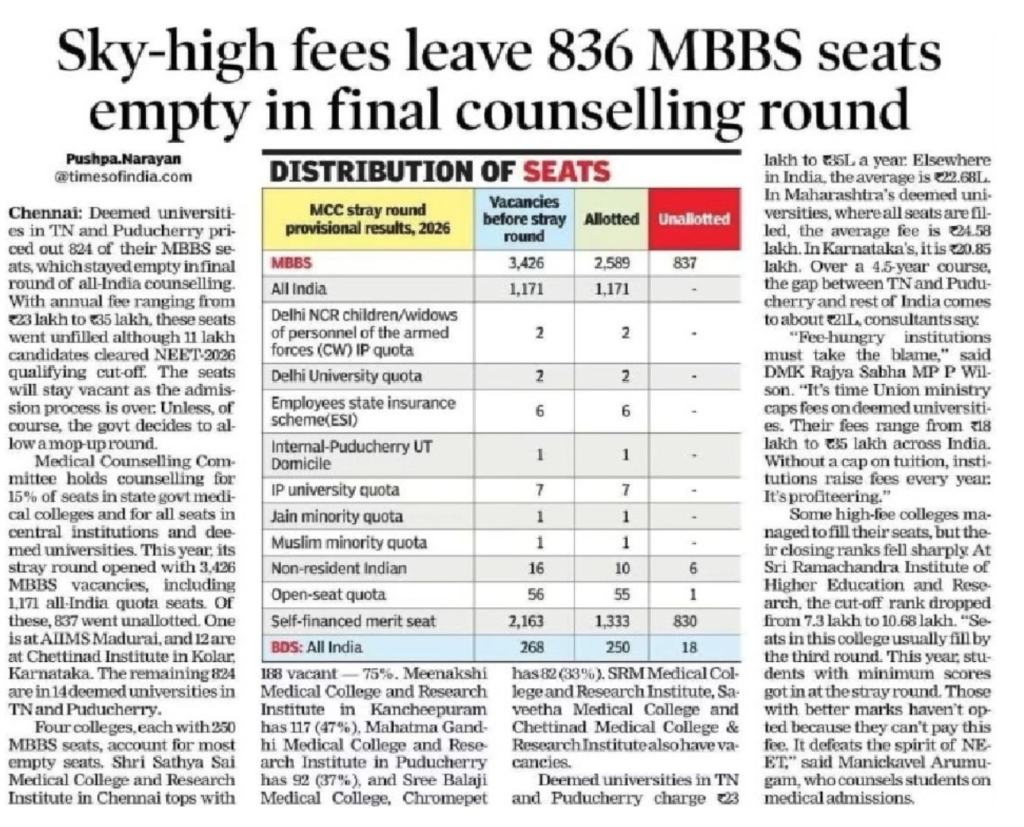
According to reports, 837 MBBS seats remained unallotted after the final counselling round, with 824 of those vacancies concentrated across 14 deemed universities in Tamil Nadu and Puducherry. Annual fees at several of these institutions were reported to range from ₹23 lakh to ₹35 lakh.
The immediate debate is about high fees.
But for an educational institution’s board, there is another question worth asking:
What should happen when a student has the merit to enter an institution but not the financial capacity to afford it?
The answer cannot simply be that educational institutions must ignore their economics. Institutions have costs, faculty, infrastructure and financial obligations.
But the board should not treat affordability as someone else’s problem.
A vacant seat is not merely an unused asset.
It can represent a student who could have been educated, a professional who could have been developed and an opportunity that the institution chose not to make accessible.
For boards of educational institutions, perhaps the bigger governance question is:
Are we maximising only financial returns from our capacity, or are we also fulfilling the educational purpose for which that capacity exists?
When an Empty Seat Is More Than an Empty Seat
An empty hotel room is unused capacity.
An empty factory line is unused capacity.
An empty classroom is also unused capacity.
But education is different.
Behind every seat is an opportunity to develop a person.
This is especially true in professional education.
A student who has cleared a highly competitive entrance examination has demonstrated academic ability. If that student cannot take the seat simply because the cost is beyond the family’s means, the institution faces a difficult question.
Not necessarily:
“Should we reduce our fees?”
But:
“Could we have done something else?”
That is a boardroom question.
1. What Is the Institution’s Purpose?
Every educational institution has financial realities.
A board is responsible for ensuring financial sustainability. Faculty must be paid. Facilities must be maintained. Technology needs investment. Accreditation requirements have costs.
Financial discipline is therefore not the enemy of educational purpose.
But boards should also be clear about the institution’s broader mission.
If an institution describes itself as being committed to excellence, merit and social impact, how does that mission translate into admission and financial-aid policies?
A board should be able to answer:
Who gets access to the opportunities we create?
And perhaps more importantly:
Does ability to pay become more important than ability to learn?
2. Should Merit and Ability to Pay Be the Same Test?
They are not.
A student may have:
- exceptional academic performance,
- the required entrance rank,
- the aptitude for the programme,
- the determination to succeed,
and still lack the financial resources to pay ₹25 to 35 lakh a year.
The recent MBBS vacancy reports illustrate this tension. Educationists and counsellors have pointed out that some higher-scoring students may opt out because they cannot afford the fees, while seats may eventually be taken by lower-scoring students with the financial capacity.
That creates a difficult question for boards:
Are we genuinely selecting for merit, or are we selecting from the subset of meritorious students who can afford the price?
The fee structure may be perfectly legitimate.
But the board should at least be willing to ask.
3. What Happens When a Student Is Deserving but Financially Constrained?
This is where governance can move beyond simply setting fees.
An institution could consider mechanisms such as:
- merit-based scholarships,
- need-based financial aid,
- partial fee waivers,
- structured payment plans,
- institutional education loans,
- alumni-funded scholarships,
- endowment-supported assistance,
- interest-free or low-cost financing,
- targeted scholarships for exceptional students.
Not every institution can implement every mechanism.
But the board can ask:
Have we explored enough options?
That is very different from asking management to simply reduce fees.
4. Could the Board Treat Scholarships as an Investment?
This is perhaps the most interesting shift in thinking.
A scholarship is often recorded as a cost.
But could the board also view it as an investment in the institution’s mission, reputation and long-term impact?
Suppose an institution has 250 seats and a meaningful number remain vacant because affordability is a barrier.
The board could ask:
Would it create more value to support a limited number of high-merit students rather than leave capacity unused?
That does not mean giving away seats indiscriminately.
It means creating a disciplined framework
For example:
Merit + Financial Need → Institutional Support → Measurable Outcome
The board can then monitor:
- number of scholarships awarded,
- academic performance,
- retention,
- graduation,
- professional outcomes,
- financial sustainability of the programme.
This turns financial assistance from an ad hoc concession into a governance mechanism.
5. What Is the Cost of an Empty Seat?
Boards naturally look at the revenue lost from an unfilled seat.
But the calculation has another side.
What is the social value lost?
A vacant MBBS seat potentially means one fewer doctor entering the healthcare system several years later.
That doesn’t mean every vacant seat automatically represents a social failure. Legitimate reasons for vacancies include counselling dynamics, student preferences, and programme-specific factors.
But when a persistent pattern emerges, boards should investigate it.
The question becomes:
Are we leaving capacity unused because demand does not exist, or because our pricing and financial-access model prevents demand from becoming enrolment?
Those are very different problems.
6. What Does the Data Tell the Board?
A good board should not react to one newspaper headline.
It should ask for evidence.
For example:
- How many qualified applicants declined admission because of fees?
- What percentage of applicants requested financial assistance?
- How many scholarships are currently available?
- What is the average fee-to-family-income profile of applicants?
- How does our fee compare with comparable institutions?
- What is our seat utilisation over five years?
- Which programmes consistently have vacancies?
- What happens to students who cannot afford the published fee?
- How much institutional capacity remains unused?
This converts a moral discussion into a governance discussion.
7. Should Every Deserving Student Be Given Financial Support?
No.
That would be neither practical nor financially responsible.
The board’s role is not to eliminate every financial barrier regardless of the institution’s economics.
It is to ensure the institution has seriously considered the barrier.
A well-designed financial-aid policy can combine:
Merit + Need + Sustainability + Accountability
That creates a more balanced approach.
The institution remains financially responsible.
The student is not simply rejected because of circumstances.
And the board can measure whether the policy is achieving its intended purpose.
8. Is This Also a Reputation Question?
Absolutely.
Educational institutions build their reputation over decades.
Students and parents increasingly look beyond rankings and infrastructure.
They also ask:
What does this institution stand for?
An institution that can demonstrate that it actively identifies exceptional students who cannot afford its fees, and has mechanisms to help them, may build a very different relationship with society.
This is not merely philanthropy.
It can become part of institutional identity.
And that is something boards should care about.
9. What Should Education Boards Be Asking?
The issue of vacant MBBS seats offers a broader framework that could apply to universities, professional institutions and even schools.
Boards could ask:
- What is our educational mission beyond financial sustainability?
- Are there qualified students we are losing primarily because of affordability?
- Do we know how many?
- Have we designed meaningful financial-aid mechanisms?
- Are scholarships based only on merit, or also on genuine financial need?
- Could we use alumni, endowment or institutional funds more effectively?
- What is the cost of leaving capacity unused?
- Are our fee structures competitive and sustainable?
- Do our admission policies reflect the values we publicly claim?
- If an exceptional student cannot afford the fee, what exactly is our institutional response?
That last question may be the most revealing.
Education Is Not Charity. But it is more than a Business.
This is where the discussion needs balance.
Educational institutions have to be financially viable.
Boards cannot ignore costs.
They cannot promise scholarships without funding them.
They cannot compromise academic standards simply to fill seats.
And they should not confuse social responsibility with financial indiscipline.
But they must avoid another extreme.
If every educational decision ultimately comes down to:
“Can the student pay?”
then the institution risks losing sight of why it exists in the first place.
The challenge for a board is to find the point where financial sustainability and educational purpose reinforce rather than undermine each other.
The Real Governance Question
The story of vacant MBBS seats is not simply about fees.
It is about what happens when capacity, merit and affordability move in different directions.
The easy response is to blame students for not being able to pay.
Another easy response is to blame institutions for charging too much.
The harder and more constructive response is to ask:
Could the institution have done something differently?
Could it have identified deserving students who needed support?
Could it have created a scholarship pool?
Could alumni have been mobilised?
Could the fee structure have been redesigned?
Could unused capacity have been converted into educational opportunity?
Management should not answer these questions alone.
The board should be willing to ask them.
Board Takeaway
A vacant seat is not always a governance failure. But a pattern of deserving students being unable to access education because of affordability should at least become a governance question.
The board’s responsibility is not to make education free.
It is to ensure that the institution’s financial model does not unintentionally undermine its educational mission.
Because ultimately, the question is not simply:
“How much can we charge for a seat?”
It is:
“What kind of institution do we want to be when a deserving student can earn the seat, but cannot afford it?”
Research Sources
The Times of India: “Sky-high fees leave 836 MBBS seats empty in final counselling round”
The report highlights 837 unallotted MBBS seats after the final counselling round, including 824 seats across deemed universities in Tamil Nadu and Puducherry, and reported fees of ₹23 to 35 lakh a year.
Learn more about Rajesh’s Independent Director and board governance perspective.